
:::
News
Fisheries Research Institute Maps Fishing Grounds of Three Spanish Mackerel Species to Support Sustainable Resource Use in Taiwan
- PostDate:2026-01-13
Spanish mackerel species (genus Scomberomorus) are economically important fish species in Taiwan’s coastal and offshore waters. During the peak fishing season, they are valued for their high oil content and desirable flesh quality, making them a common feature on dining tables in Taiwan. However, catches have declined in recent years, raising concerns among both fishers and consumers. Research conducted by the Fisheries Research Institute of the Ministry of Agriculture examined the fishing seasons and distribution of three Spanish mackerel species in waters surrounding Taiwan. The fishing grounds of Scomberomorus commerson (toto) are widely distributed around Taiwan, while Scomberomorus niphonius (maga) occurs mainly along the northeastern and western coasts. In contrast, Scomberomorus guttatus (baifuzi) is primarily found in offshore waters north of central Taiwan. These findings provide a basis for more sustainable use of Spanish mackerel resources.
The Fisheries Research Institute reported that Spanish mackerel populations have been affected by both fishing pressure and climate change in recent years, with catches remaining at relatively low levels over an extended period. However, the lack of continuous and systematic monitoring data in Taiwan has made it difficult to assess fishing conditions with precision. To address this gap, the Institute built on long-term monitoring efforts through the “Spanish Mackerel Fishery Condition Rapid Report Station,” established more than fifty years ago. Researchers collaborated with sample vessel captains to compile and integrate multiple data sources, including catch logs, voyage recorder data, and port inspection records. These data were then used to conduct a systematic analysis of the fishing seasons and spatial distribution of the three Spanish mackerel species in waters surrounding Taiwan.
The study found that among the three Spanish mackerel species, Scomberomorus commerson accounted for the highest catches, followed by Scomberomorus niphonius and Scomberomorus guttatus. The main fishing season of all three species extends from autumn to the following spring, although their spatial distributions differ. Scomberomorus commerson is widely distributed across waters surrounding Taiwan, while Scomberomorus niphonius is concentrated along the northeastern and western coasts. In contrast, Scomberomorus guttatus occurs primarily in offshore waters north of central Taiwan.
In the future, the Fisheries Research Institute will continue to monitor changes in Spanish mackerel resources. The Institute also plans to introduce satellite remote sensing and integrate these data AI-based species distribution models to better understand habitat conditions and dynamic patterns. These approaches are expected to support more precise fishing practices while taking into account energy efficiency, carbon reduction, and sustainable resource use. In addition, the results will contribute to scientific management and long-term sustainability of coastal and offshore fisheries.
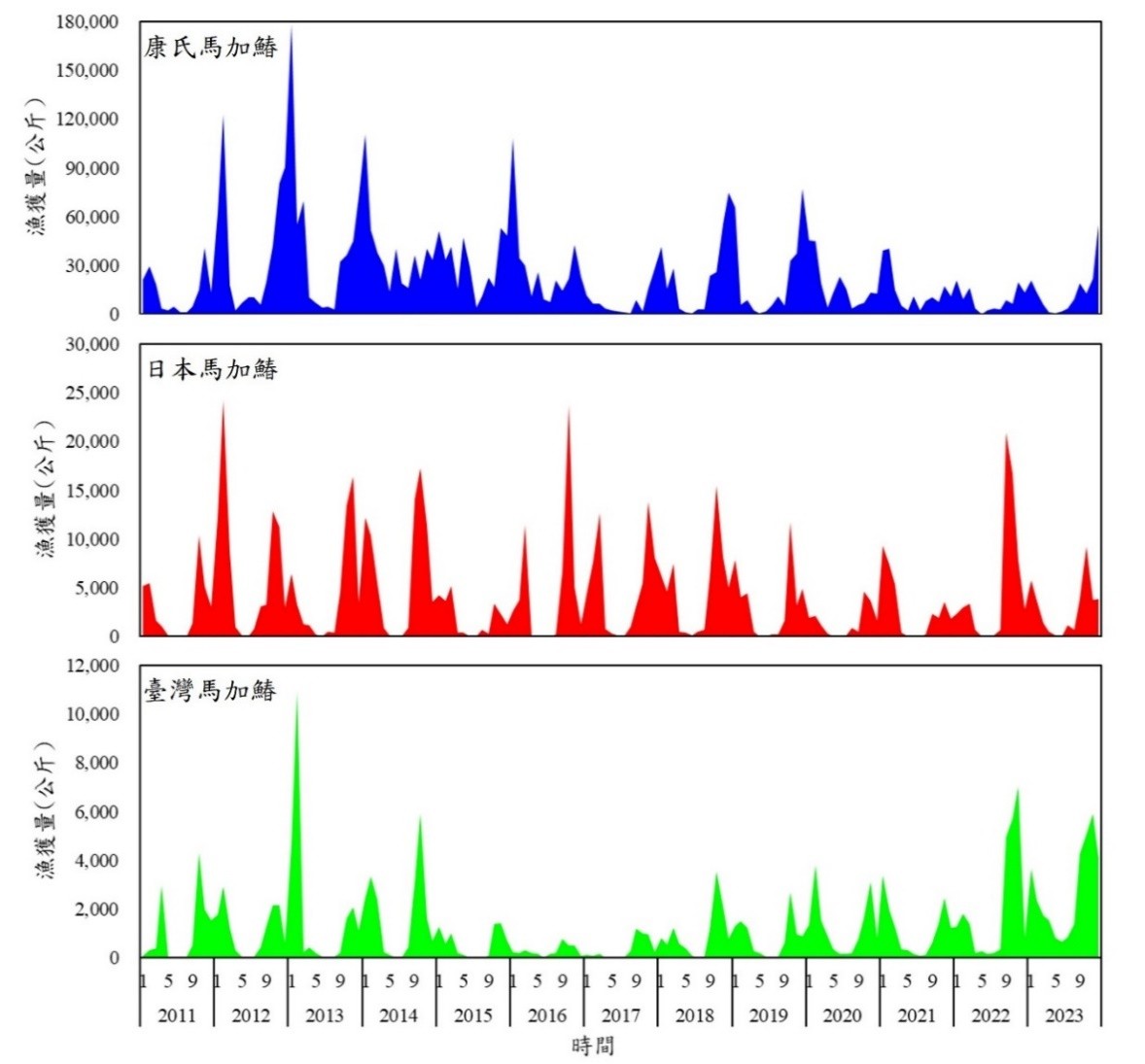
Figure 1. Catch variation of three Spanish mackerel species (Scomberomorus) in Taiwan, 2011–2023.
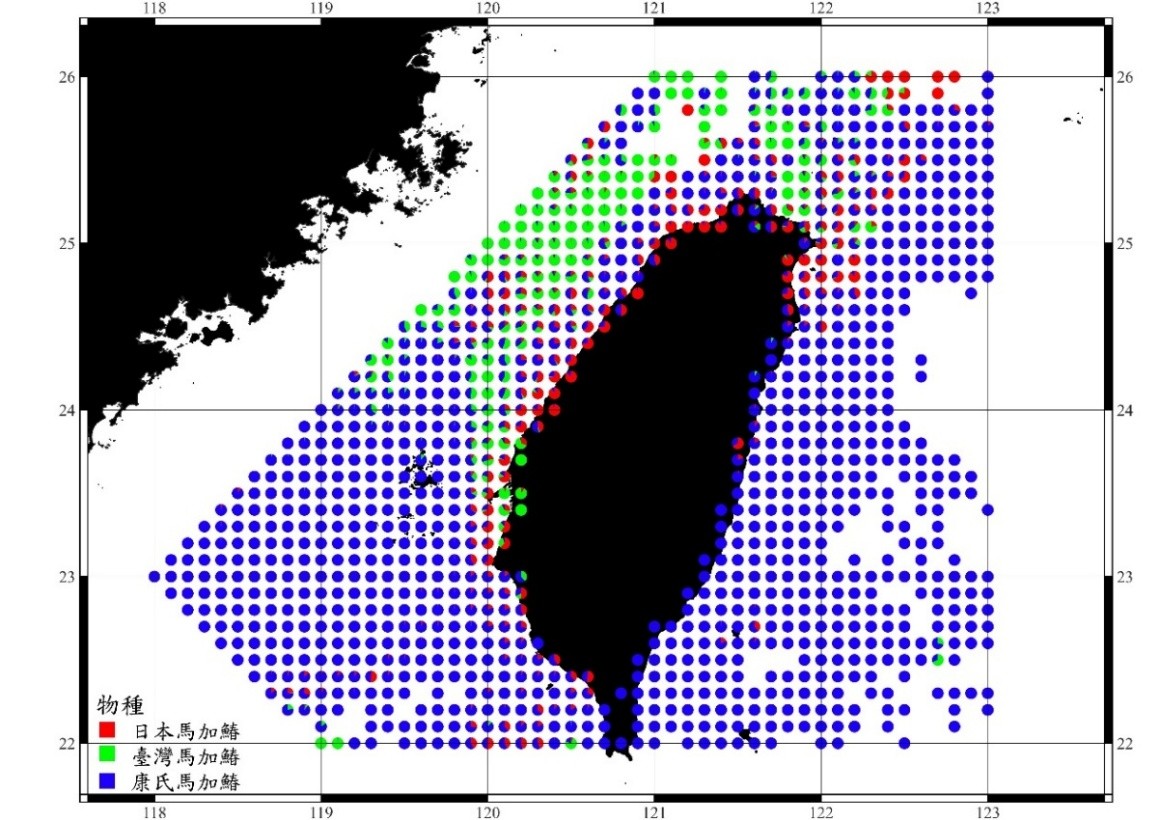
Figure 2. Fishing grounds of the three Spanish mackerel species (Scomberomorus) in waters surrounding Taiwan.
The Fisheries Research Institute reported that Spanish mackerel populations have been affected by both fishing pressure and climate change in recent years, with catches remaining at relatively low levels over an extended period. However, the lack of continuous and systematic monitoring data in Taiwan has made it difficult to assess fishing conditions with precision. To address this gap, the Institute built on long-term monitoring efforts through the “Spanish Mackerel Fishery Condition Rapid Report Station,” established more than fifty years ago. Researchers collaborated with sample vessel captains to compile and integrate multiple data sources, including catch logs, voyage recorder data, and port inspection records. These data were then used to conduct a systematic analysis of the fishing seasons and spatial distribution of the three Spanish mackerel species in waters surrounding Taiwan.
The study found that among the three Spanish mackerel species, Scomberomorus commerson accounted for the highest catches, followed by Scomberomorus niphonius and Scomberomorus guttatus. The main fishing season of all three species extends from autumn to the following spring, although their spatial distributions differ. Scomberomorus commerson is widely distributed across waters surrounding Taiwan, while Scomberomorus niphonius is concentrated along the northeastern and western coasts. In contrast, Scomberomorus guttatus occurs primarily in offshore waters north of central Taiwan.
In the future, the Fisheries Research Institute will continue to monitor changes in Spanish mackerel resources. The Institute also plans to introduce satellite remote sensing and integrate these data AI-based species distribution models to better understand habitat conditions and dynamic patterns. These approaches are expected to support more precise fishing practices while taking into account energy efficiency, carbon reduction, and sustainable resource use. In addition, the results will contribute to scientific management and long-term sustainability of coastal and offshore fisheries.
Figure 1. Catch variation of three Spanish mackerel species (Scomberomorus) in Taiwan, 2011–2023.
Figure 2. Fishing grounds of the three Spanish mackerel species (Scomberomorus) in waters surrounding Taiwan.
Oyster Shucking Workshop on Human–Machine Collaboration and Quality Enhancement for Domestic Oysters Demonstrates High Pressure Processing to Support Modernization of the Oyster Industry
Aquatic Ark Sets Sail! Tungkang Shrimp and Algae Germplasm Bank Begins Operation, Strengthening Taiwan’s Shrimp Industry