
:::
News
Fisheries Research Institute Develops Rapid Test Strip to Identify Mullet Lineages and Support Climate Resilience in Aquaculture
- PostDate:2026-03-24
The Fisheries Research Institute under the Ministry of Agriculture has applied molecular identification techniques to develop a rapid test strip for identifying mullet lineages. The tool enables aquaculture operators to quickly determine the origin of fry and select lineages suited to local environmental conditions. This development is expected to strengthen the resilience of Taiwan’s mullet aquaculture sector by improving stock selection and reducing climate-related production risks, thereby supporting more stable industry development.
The Fisheries Research Institute notes that mullet are often referred to as “black gold” due to the high market value of mullet roe, and that the species plays a significant role in Taiwan’s coastal fisheries and aquaculture. Mullet populations in waters adjacent to Taiwan in the northwestern Pacific can be broadly classified into three lineages, such as temperate, Kuroshio, and tropical, each associated with different temperature ranges. At present, aquaculture production relies largely on wild-caught fry. In this context, accurate identification of fry lineage and the selection of strains suited to local environmental conditions have become important for sustaining production under changing climatic conditions.
The research team of the Fisheries Research Institute reported that previous studies have identified clear differences in reproductive traits among females from different lineages, with direct implications for the production potential of mullet roe. After three years of cultivation, females from the temperate lineage exhibited relatively low gonadosomatic indices, and their ovaries showed little or no development. In contrast, females from the Kuroshio lineage had higher gonadosomatic indices and showed active ovarian development, suggesting greater potential for mullet roe production. Tropical lineage females showed the strongest performance overall, with both body weight and ovary weight exceeding those of the Kuroshio lineage by a clear margin, indicating potential for producing larger and higher-quality mullet roe.
The Institute further noted that the newly developed rapid test strip enables rapid identification of lineage origin in mullet fry and broodstock. This provides a basis for evidence-based broodstock selection and artificial propagation. The Institute also indicated that it plants to further refine the testing technology and support aquaculture operators in developing a more climate-resilient and competitive mullet industry.
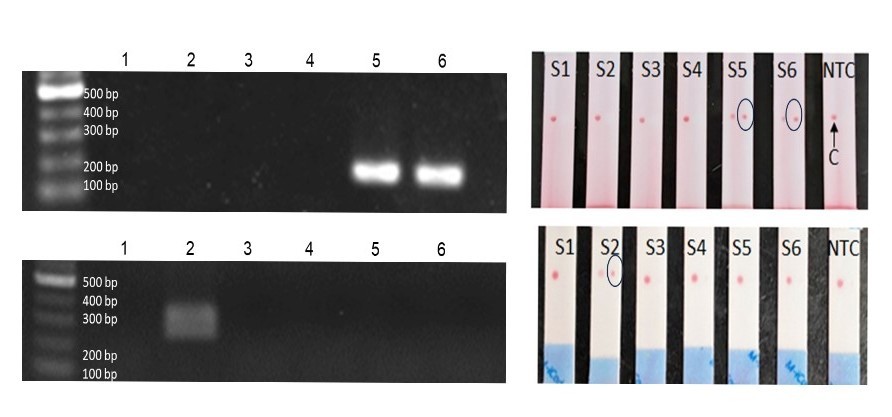
Figure 1. Rapid test strip identification of mullet lineages. Samples 1, 3, and 4 correspond to the Kuroshio lineage; sample 2 corresponds to the tropical lineage; and samples 5 and 6 correspond to the temperate lineage. The left image shows agarose gel electrophoresis results, and the right image shows color development on the test strip. Circles indicate detection signals for each sample. Test strip results are consistent with PCR electrophoresis results. C, test strip quality control point; NTC, no template control.
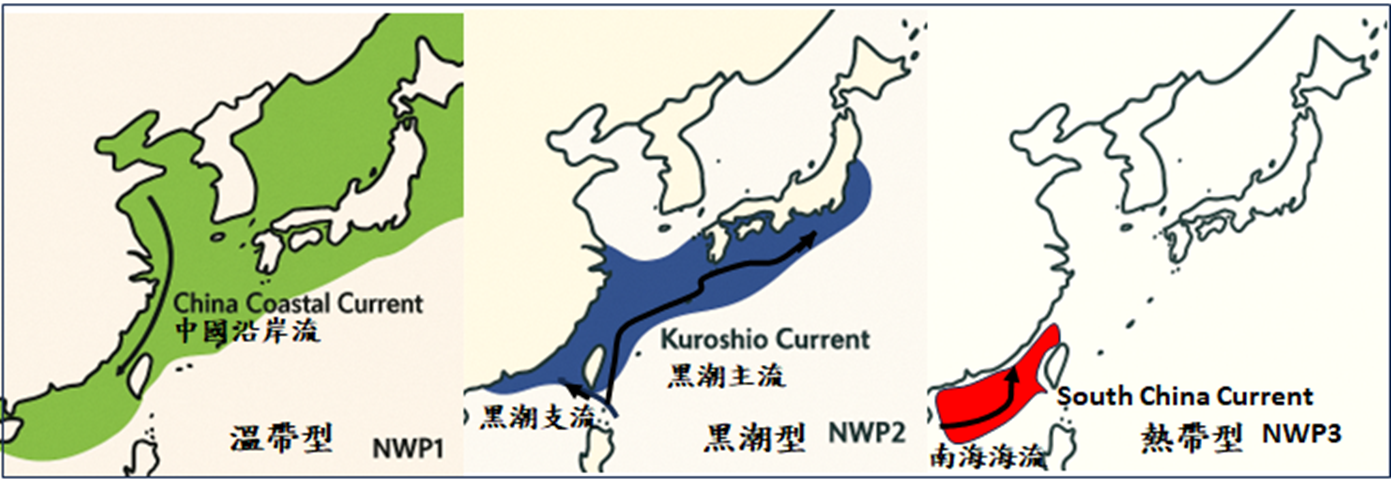
Figure 2. Mullet populations in waters adjacent to Taiwan in the northwestern Pacific can be classified into three major lineages (temperate, Kuroshio, and tropical), each associated with different temperature ranges (adapted from Shen, 2011)
The Fisheries Research Institute notes that mullet are often referred to as “black gold” due to the high market value of mullet roe, and that the species plays a significant role in Taiwan’s coastal fisheries and aquaculture. Mullet populations in waters adjacent to Taiwan in the northwestern Pacific can be broadly classified into three lineages, such as temperate, Kuroshio, and tropical, each associated with different temperature ranges. At present, aquaculture production relies largely on wild-caught fry. In this context, accurate identification of fry lineage and the selection of strains suited to local environmental conditions have become important for sustaining production under changing climatic conditions.
The research team of the Fisheries Research Institute reported that previous studies have identified clear differences in reproductive traits among females from different lineages, with direct implications for the production potential of mullet roe. After three years of cultivation, females from the temperate lineage exhibited relatively low gonadosomatic indices, and their ovaries showed little or no development. In contrast, females from the Kuroshio lineage had higher gonadosomatic indices and showed active ovarian development, suggesting greater potential for mullet roe production. Tropical lineage females showed the strongest performance overall, with both body weight and ovary weight exceeding those of the Kuroshio lineage by a clear margin, indicating potential for producing larger and higher-quality mullet roe.
The Institute further noted that the newly developed rapid test strip enables rapid identification of lineage origin in mullet fry and broodstock. This provides a basis for evidence-based broodstock selection and artificial propagation. The Institute also indicated that it plants to further refine the testing technology and support aquaculture operators in developing a more climate-resilient and competitive mullet industry.
Figure 1. Rapid test strip identification of mullet lineages. Samples 1, 3, and 4 correspond to the Kuroshio lineage; sample 2 corresponds to the tropical lineage; and samples 5 and 6 correspond to the temperate lineage. The left image shows agarose gel electrophoresis results, and the right image shows color development on the test strip. Circles indicate detection signals for each sample. Test strip results are consistent with PCR electrophoresis results. C, test strip quality control point; NTC, no template control.
Figure 2. Mullet populations in waters adjacent to Taiwan in the northwestern Pacific can be classified into three major lineages (temperate, Kuroshio, and tropical), each associated with different temperature ranges (adapted from Shen, 2011)